How to use flanger with guitar
A flanger is a chorus with one extra knob, and that knob does everything. Learn what feedback does and the whole effect makes sense, from a subtle metallic shimmer to the full jet-plane sweep.
CrossWire field notes. The rig below is a real, recallable one (classic seed 19), so you can hear where a low-feedback flanger sits before you push it into a jet.
Play a flanger and a chorus back to back at low settings and they sound almost the same: a widening, watery movement. Turn one knob and they split apart. That knob is FEEDBK, and it is what makes a flanger a flanger. It feeds the effect's own output back into its input, so the comb filter regenerates and the gentle sweep sharpens into the metallic, jet-engine whoosh the effect is famous for.
The FLANGER node, knob by knob
Four controls, all 0 to 10, defaulting to RATE 3.0, DEPTH 6.0, FEEDBK 5.0, MIX 5.0. RATE is how fast the sweep cycles, DEPTH is how far it travels, MIX is wet against dry. FEEDBK is the one that changes the effect's character rather than its amount: low is a metallic chorus, high is an event.
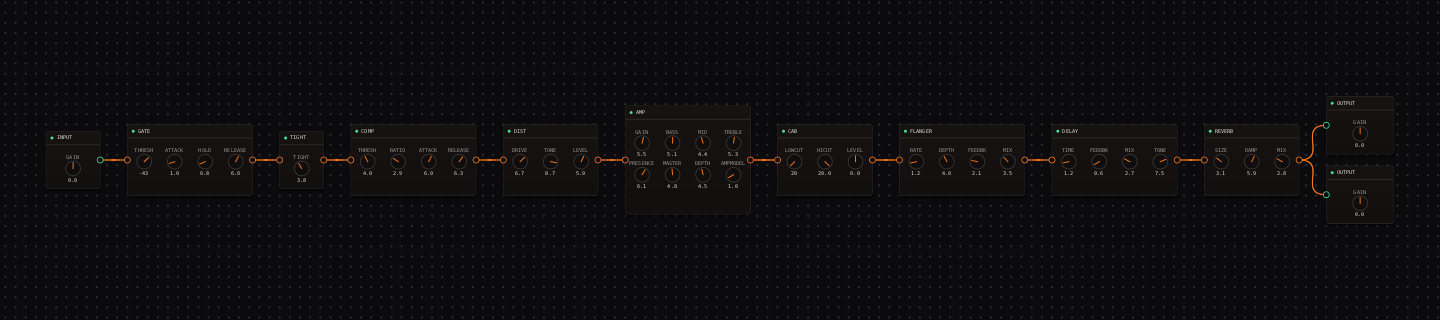
Three voicings map the whole range
The FLANGER node's voicing dropdown is honest about how wide its range is. Start from one of these rather than the raw defaults. Values are RATE · DEPTH · FEEDBK · MIX.
| Voicing | Values | What it is |
|---|---|---|
| jet | 2.5 · 8.0 · 7.5 · 6.0 | The full flyover. Save it for a moment, not a whole song. |
| subtle | 1.5 · 4.0 · 3.0 · 4.0 | Slow, low-feedback movement that survives a dense mix. |
| chorus-flange | 3.5 · 6.0 · 2.0 · 5.0 | The between-worlds setting: wider than chorus, tamer than jet. |
How to dial it in
- Set FEEDBK last. Get RATE and DEPTH musical at FEEDBK 2.0, then raise feedback until the sweep asserts itself. Feedback multiplies whatever the sweep is already doing, so a bad sweep gets worse and a good one gets iconic.
- Match RATE to the part, not the tempo. A flanger cycling faster than the phrase reads as warble. For strummed parts, one sweep per bar or slower (RATE under 3) almost always sits better.
- Audition pre-amp saturation. Rewire the FLANGER ahead of the AMP (click a wire, press Delete, drag a new one) and compare at matched level. Saturated flanging is darker and angrier, the right call maybe one time in five and unmistakable when it is.
Flanger on guitar: quick answers
- What is the difference between a flanger and a chorus?
- One knob: feedback. A chorus mixes in a delayed, detuned copy and stops there. A flanger feeds that copy back on itself, and the regeneration builds the sweeping comb filter you hear as the jet. Low feedback gives you a metallic chorus; high feedback gives you the flyover.
- What are good flanger settings for guitar?
- Start from a voicing rather than the raw knobs, because a flanger punishes random settings more than most effects. "subtle" (feedback 3.0) sits inside a band mix, "jet" (feedback 7.5) is a moment effect, and "chorus-flange" (feedback 2.0) is the tame in-between. Get rate and depth musical first, then raise feedback last.
- Should a flanger go before or after the amp?
- After the cab the sweep is clean and hi-fi. Moved in front of the amp, the drive saturates the comb filter and the effect turns grittier and more vintage. Both are valid; the graph makes the comparison a thirty-second rewire, so try both at matched level before deciding.
Hear it in a real rig
Open the Randomizer, paste a seed, click Recall, and the canvas rebuilds.
- Classic seed 19: the post-cab flanger in the screenshot.
- Rig Market: community rigs that use FLANGER.
- Tutorials: 14 recallable rigs to graft a flanger onto.
Get the CrossWire demo → Standalone app and CLAP plugin, full fidelity, every seed recalls exactly.