How to use phaser with guitar
The phaser is the modulation you can leave on all day. It swirls without shouting, and the only real decision is which side of the amp it lives on. Here is how that one choice shapes everything else.
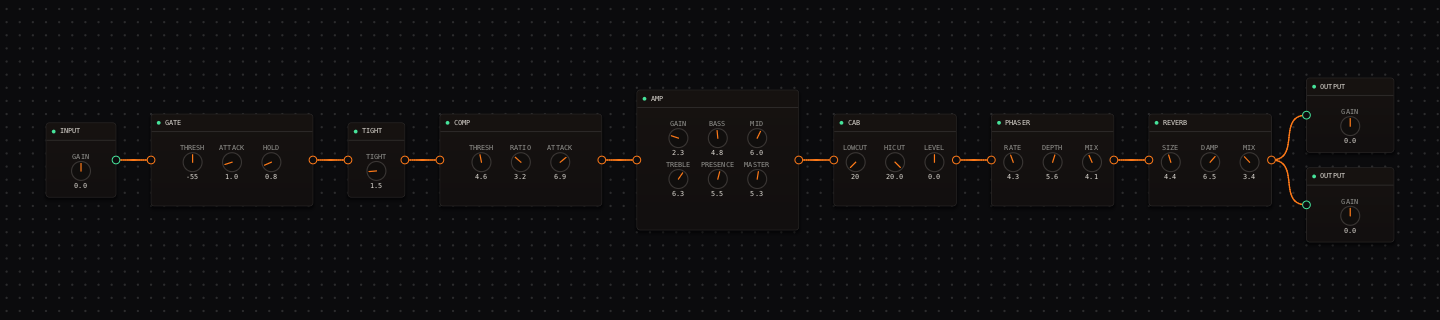
CrossWire field notes. The rig below is real and recallable (classic seed 2), a phaser sitting after the cab where the sweep stays clean.
A phaser moves a set of notches up and down through your signal, and the sound is a rounded, vocal swirl rather than the metallic sweep of a flanger. It has no feedback knob to run away with, which is exactly why it is the modulation guitarists trust to stay musical through an entire take. The craft is less about the knobs than about where you put it.
Make the placement decision first
Pre-amp phasing is saturated and vintage: the driven front end chews on the notches and the swirl becomes part of the distortion. Post-cab phasing is clean and wide, a hi-fi wash over a finished tone. These are two different effects from the same node, so choose the side before you touch RATE or DEPTH.
Three voicings, three eras
The PHASER node keeps it to RATE, DEPTH and MIX (0 to 10, defaulting to 3.0 / 6.0 / 5.0). Its three voicings cover the effect's whole history. Values are RATE · DEPTH · MIX.
| Voicing | Values | What it is |
|---|---|---|
| phase90 | 3.5 · 6.0 · 5.0 | The default seventies swirl. Works on rhythm and lead alike. |
| slow-sweep | 1.0 · 8.0 · 5.0 | One long wave per phrase. Deep without being busy. |
| univibe | 5.0 · 5.0 · 6.0 | Faster and wetter, the throbbing end of the family. |
Two habits that keep it musical
- Ride DEPTH, not MIX. MIX at 5.0 keeps a healthy dry center. Pulling MIX down to reduce the swirl just thins the voice into a whisper. Drag DEPTH down instead and the sweep gets shallower while the tone stays full.
- Slow it down for driven parts. Distortion exaggerates the notches. Under a driven amp, drop RATE toward 2.0 or the sweep starts fighting the picking hand.
Phaser on guitar: quick answers
- What is the difference between a phaser and a flanger?
- A phaser has no feedback control and no comb-filter scream. Its swirl comes from shifting the phase of a few frequency notches, which is gentler and rounder than a flanger sweep. That is why a phaser tolerates being left on for a whole song where a flanger would wear out its welcome.
- Should a phaser go before or after the amp?
- Historically before. The classic seventies rigs ran a phaser into a driven front end, and the saturation makes the notches part of the distortion. For a cleaner, more modern sweep, move it after the cab instead. Decide that first, because everything else you dial depends on it.
- What are the classic phaser settings?
- The three voicings map its history. "phase90" (rate 3.5) is the pedal on every seventies record, "slow-sweep" (rate 1.0, depth 8.0) is the long cinematic version, and "univibe" (rate 5.0, mix 6.0) leans wetter and choppier toward the rotary throb.
Hear it in a real rig
Open the Randomizer, paste a seed, click Recall.
- Classic seed 2: the post-cab phaser in the screenshot.
- Rig Market: community rigs that use PHASER.
- Tutorials: recall any rig, then add a PHASER from the right-click toolbox.
Get the CrossWire demo → Standalone app and CLAP plugin, full fidelity, every seed recalls exactly.