How to use fuzz with guitar
Fuzz is the wild top end of the DIST node, and it splits into two great families that behave nothing alike. One is an expressive instrument you play with your volume pot; the other is a wall you build with.
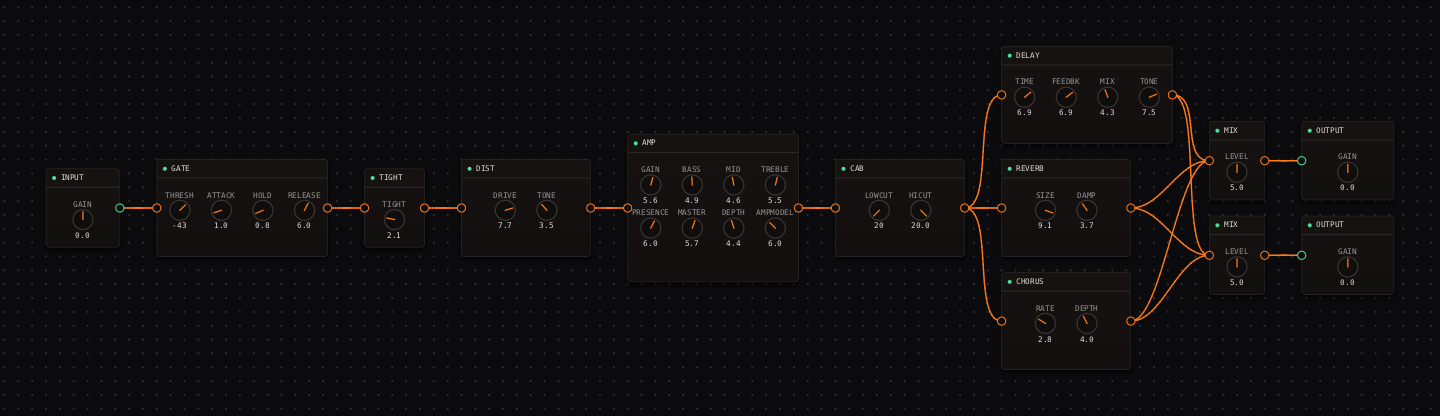
CrossWire field notes. The rig below is real and recallable: a big-muff wall from the shoegaze tutorial, with the fuzz doing the compression.
CrossWire has no separate fuzz node. Fuzz is what the DIST node does at the top of its range, and two of its voicings are the two circuits that matter. "fuzz-face" is the saggy vintage sound that cleans up dramatically from the guitar's volume pot. "big-muff" is the thick, sustaining wall that does not. Knowing which one you want is the whole craft.
Two families, two jobs
A fuzz-face setting is an expressive instrument. Volume at 10 is mayhem, at 6 a fat crunch, at 4 nearly clean, and you play the whole range from the guitar. A muff setting is a building material. It sustains forever and reads as architecture, which is why the shoegaze rig uses it as both the compressor and the foundation at once.
The three fuzz voicings
These sit at the top of the DIST node's dropdown. Values are DRIVE · TONE · LEVEL.
| Voicing | Values | What it is |
|---|---|---|
| fuzz-face | 9.0 · 4.5 · 5.0 | Vintage sag. Lives and dies by the guitar volume pot. |
| big-muff | 8.5 · 4.0 · 5.0 | Sustain-for-days wall. The shoegaze rig's core. |
| culture-vulture | 6.5 · 5.5 · 5.0 | The tube-drive cousin when full fuzz is too much. |
Getting it right
- Play the volume pot, not the node. Recall the fuzz-face voicing, set the rig loud, and do the whole soundcheck from your guitar's volume knob.
- Keep TONE dark and cut at the cab. Fuzz brightness is harsh in a way amp brightness is not. Leave DIST TONE at or below 4.5 and use CAB HICUT to place the top end.
- Check the gate against the sustain. Fuzz rings forever, and a mis-set gate amputates it. Hold a note to silence: if the tail clips, drag GATE THRESH down or RELEASE up before blaming the fuzz.
Fuzz on guitar: quick answers
- Is there a separate fuzz pedal in CrossWire?
- No. Fuzz is the top of the DIST node's range. Two of its voicings are the two great fuzz families: "fuzz-face" (9.0 · 4.5 · 5.0), the saggy vintage circuit, and "big-muff" (8.5 · 4.0 · 5.0), the thick sustaining wall.
- How do I get a fuzz to clean up from my guitar volume?
- Use the fuzz-face voicing, which is built for it, and do your whole soundcheck from the guitar's volume knob. At 10 it is mayhem, at 6 a fat crunch, at 4 nearly clean. If the cleanup range feels small, drag DRIVE down a step. That range is what you are tuning.
- Why does my fuzz sound broken or thin?
- Fuzz needs an amp with real character behind it. Into a sterile platform it just sounds broken. Put a plexi or tweed model after it, keep TONE dark (at or below 4.5), and place the top end with the cab's HICUT rather than the fuzz.
Hear it in a real rig
Open the Randomizer, paste a seed, click Recall.
- Shoegaze tutorial: the muff wall with a gate on a leash (the screenshot).
- Distortion guide: the rest of the DIST node's families.
- Rig Market: community rigs that use DIST.
Get the CrossWire demo → Standalone app and CLAP plugin, full fidelity, every seed recalls exactly.