How to use distortion with guitar
Distortion is not one sound with a volume knob. It is a handful of different families, and picking the right one matters far more than how hard you push it. Here is the map, with two real rigs at opposite ends.
CrossWire field notes. Both rigs pictured are real and recallable: a rat-flavored punk grind and a big-muff shoegaze wall.
The DIST node shares the overdrive knob set (DRIVE, TONE, LEVEL, all defaulting to 5.0) but its ten voicings cover the harder territory. The single most useful thing to know is that those voicings are not ten amounts of one distortion. They are different instruments. A rat and a big-muff at the same DRIVE are as different as two amps, so the first decision is always the family.
The families, at a glance
- Rat grind. Mid-forward and cutting, built for a British amp. This is the punk rig below.
- Muff fuzz. Thick, dark, endless sustain. Works as its own compressor. This is the shoegaze wall.
- Scooped metal. Bright and mid-cut for tight, fast rhythm.
- Saturation. tape-sat and console-sat are barely distortion at all, a glue for clean tones rather than grit.
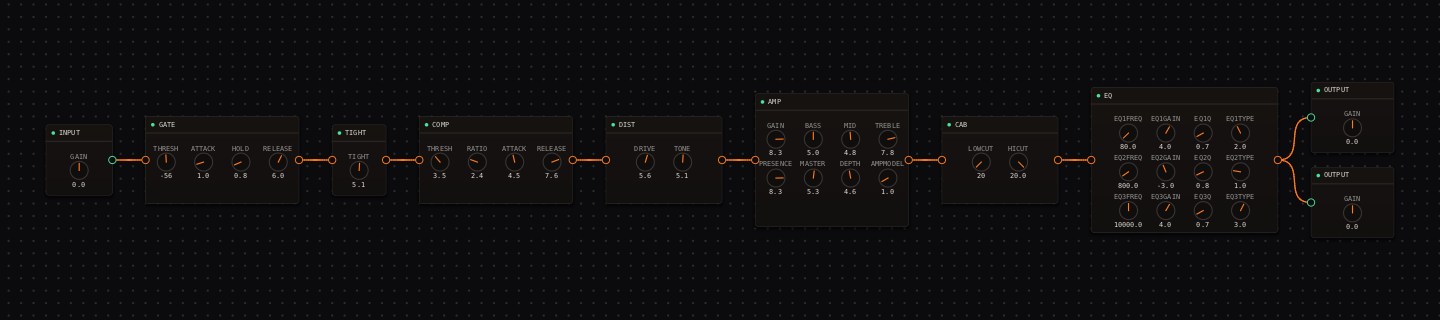
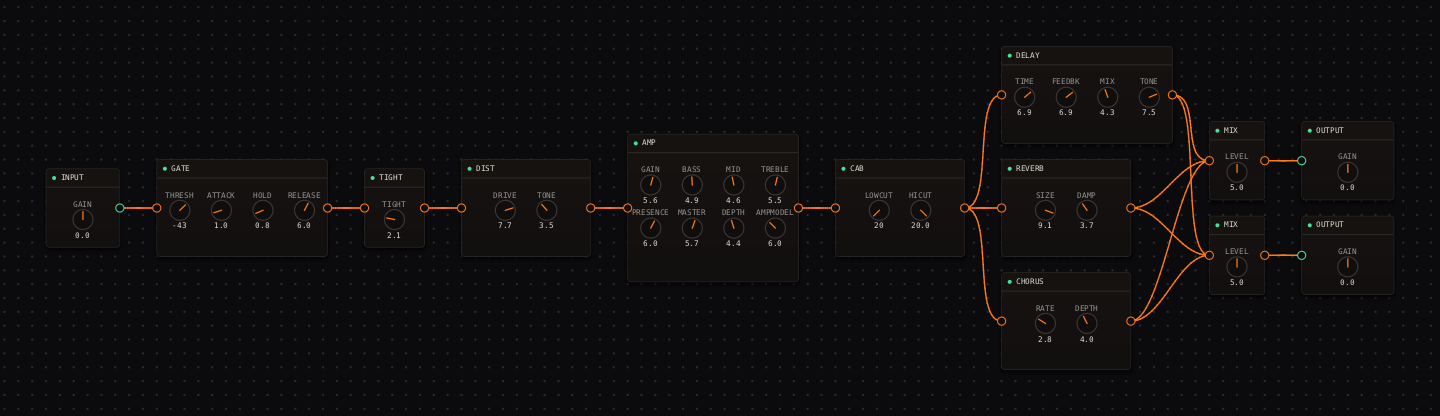
Ten voicings, grind to glue
These are the exact entries on the DIST node's voicing dropdown. Values are DRIVE · TONE · LEVEL.
| Voicing | Values | What it is |
|---|---|---|
| rat | 6.0 · 5.0 · 5.0 | Mid-grind that loves a British amp. The punk rig's family. |
| big-muff | 8.5 · 4.0 · 5.0 | Thick, dark sustain. The shoegaze rig lives here. |
| metal | 7.5 · 8.0 · 5.0 | Bright, scooped aggression for tight rhythm. |
| fuzz-face | 9.0 · 4.5 · 5.0 | Saggy vintage fuzz that cleans up from the guitar volume. |
| metal-planet | 9.0 · 8.5 · 5.0 | The extreme bright high-gain corner. |
| alpha-omega | 7.0 · 6.0 · 5.5 | Modern bass-forward distortion. |
| culture-vulture | 6.5 · 5.5 · 5.0 | Tube/pentode-style harmonic dirt. |
| distortion | 7.0 · 6.0 · 5.0 | The generic reference pedal. |
| tape-sat | 3.0 · 5.0 · 5.5 | Soft tape-style saturation, barely distortion at all. |
| console-sat | 2.5 · 5.5 · 5.5 | Subtle console drive for a finished clean tone. |
One more use worth trying: drop tape-sat (3.0 · 5.0 · 5.5) after a clean amp and cab and you get glue, not grit. It is the cheapest way to make a sterile clean tone sound recorded.
Distortion on guitar: quick answers
- What is the difference between overdrive and distortion?
- Overdrive nudges an amp into breakup and stays touch-sensitive. Distortion generates its own heavy clipping and holds it, so the sound is more consistent and more aggressive. In CrossWire they share a knob set, but the DIST node's voicings reach into the harder families: rat grind, muff fuzz, scooped metal.
- How do I choose a distortion setting?
- Pick a family before you touch a knob. rat, big-muff, metal and fuzz-face are different instruments, not different amounts of the same thing. Choose the family against your song from the voicing dropdown, then adjust DRIVE within it.
- Why does my distortion sound harsh in a band mix?
- Bright distortion fights cymbals and vocals. Keep TONE at or below the middle and let the amp's own PRESENCE knob place the top end. Both published distortion rigs keep TONE dark for exactly this reason.
Hear these in a real rig
Open the Randomizer, paste a seed, click Recall.
- Punk tutorial: rat-style DIST into a cranked 800 (the first screenshot).
- Shoegaze tutorial: the dark muff wall (the second screenshot).
- Fuzz guide: the top of this node's range, in detail.
- Rig Market: community rigs that use DIST.
Get the CrossWire demo → Standalone app and CLAP plugin, full fidelity, every seed recalls exactly.