How to play volume swells with guitar
A volume swell is a playing technique, but the rig is what makes it sing. Here is the graph that holds a swell together, and the one trick a pedalboard cannot do: wiring the swell to play itself.
CrossWire field notes. The rigs below are real and recallable, both built so the tails ring long enough for a slow swell to land inside the previous note.
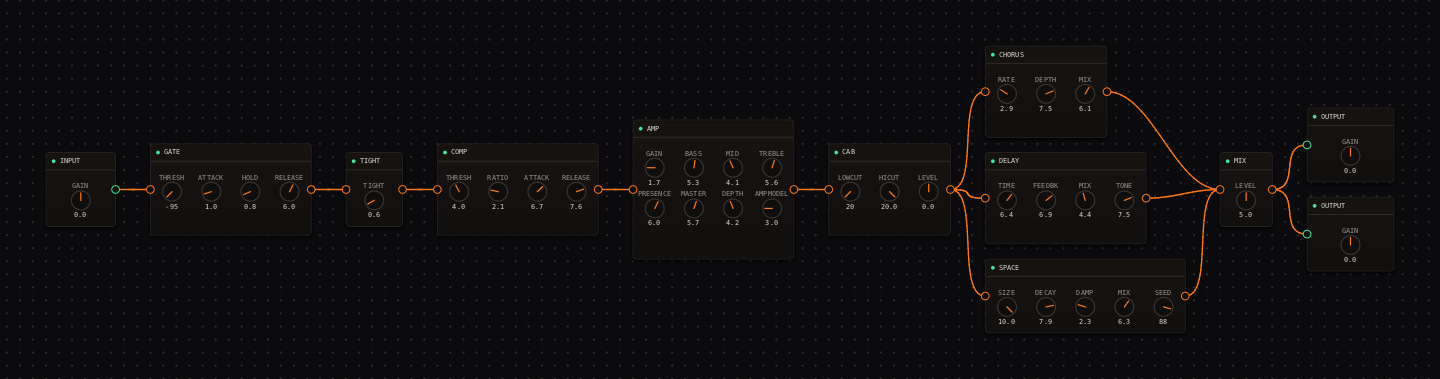
A volume swell is simple to describe and hard to place: pick with the guitar volume at zero, then roll it up so the note blooms without an attack. What the rig contributes is the tail. In CrossWire, DELAY, REVERB and SPACE nodes keep ringing on their own state, so everything you swelled into keeps decaying while you prepare the next swell at silence. A parallel wet lane is ideal, because the dry lane vanishes when you roll down while the wet lanes carry the pad.
The trick a pedalboard cannot do
Every continuous knob exposes a blue mod pin on its node's bottom edge (hover one and the tooltip reads "mod: LEVEL", "mod: MIX" and so on). Drag from any node's output port to that pin and the source signal drives the knob. Add an OSCILLATOR from the right-click toolbox, set a slow sine, and wire it into a MIX node's LEVEL pin. The lane now breathes on its own, and your hands are free to play into it.
Two things to get right
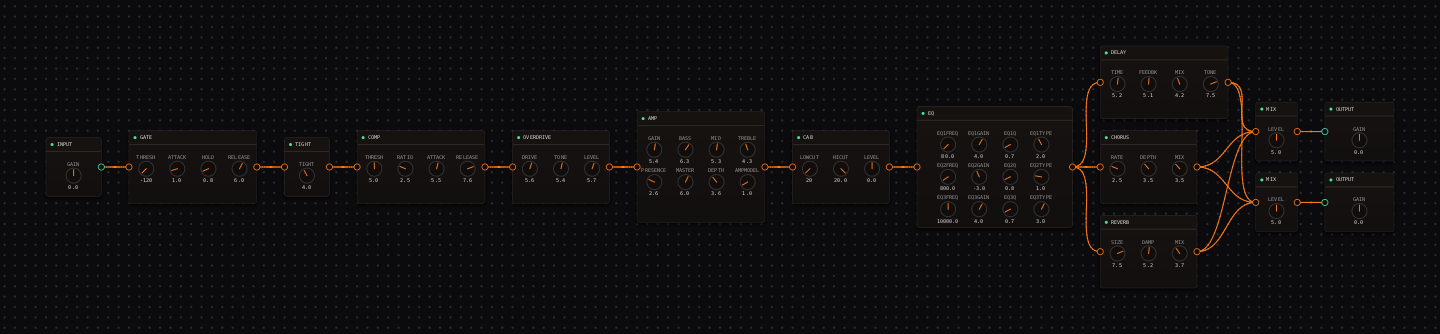
- Park the GATE off. A swell starts below the noise floor. Drag THRESH below -90 until it reads "off", or an engaged gate chops the quiet start of every swell.
- Give the tails room. Settings that would be excessive for picked parts are correct here, because the attack never happens. Push DELAY feedback to 6 or 7 and SPACE or REVERB mix past 5.
Volume swells: quick answers
- How do you play a volume swell on guitar?
- Pick a note with the guitar volume at zero, then roll the volume up so the note blooms in with no attack. The rig contributes the tail: DELAY, REVERB and SPACE keep ringing on their own, so what you swelled into keeps decaying while you set up the next swell at zero.
- What rig settings help volume swells?
- Keep the core clean, because swells into distortion read as fade-ins rather than bowing. Give the tails somewhere to live: DELAY feedback up around 6 to 7, and SPACE or REVERB mix past 5. Park the GATE off, or it will chop the quiet start of every swell.
- Can CrossWire automate a volume swell?
- Yes, with a control wire. Every continuous knob has a blue mod pin on its node's bottom edge. Drag from an OSCILLATOR's output to a MIX node's LEVEL pin, set a slow sine, and the lane swells itself with no hands.
Hear it in a real rig
Open the Randomizer, paste a seed, click Recall.
- Ambient tutorial: the reference swell platform (the first screenshot).
- Indie tutorial: parallel tails that survive a volume rolled to zero.
Get the CrossWire demo → Standalone app and CLAP plugin, full fidelity, every seed recalls exactly.