How to use overdrive with guitar
A good overdrive is rarely the star of a rig. It is the hand that pushes the amp. Here are three real rigs that use the same node three completely different ways, from a fraying blues crunch to a tight metal boost.
CrossWire field notes. Both rigs pictured are real and recallable, so you can hear the pedal working the amp rather than replacing it.
The most common overdrive mistake is asking the pedal to be the distortion. In a good CrossWire rig the OVERDRIVE node keeps DRIVE moderate and LEVEL healthy, and it lets the amp's own stages do the clipping. LEVEL into a driven amp adds aggression; DRIVE adds pedal fuzz. Learn that reflex and the node stops fighting your amp and starts feeding it.
The same node, three jobs
Blues: push a fraying amp
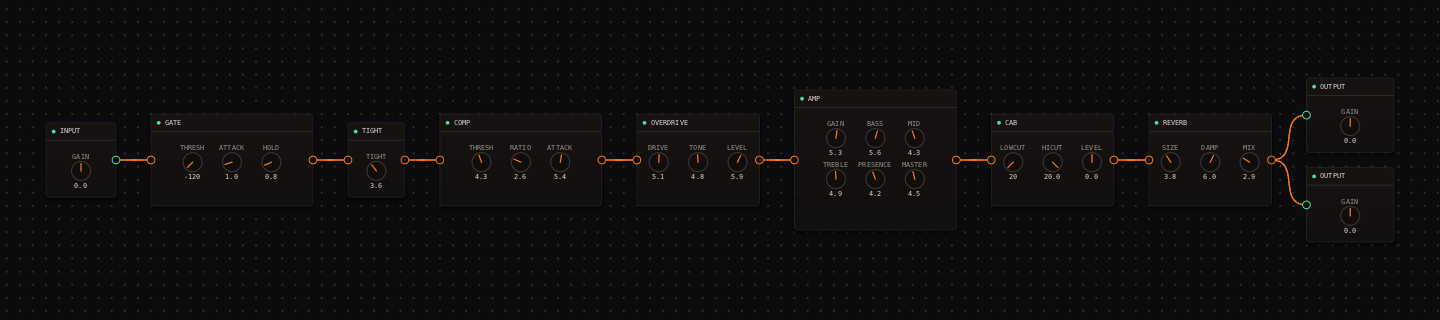
OVERDRIVE 5.1 · 4.8 · 5.9 into a JCM800 2204 at GAIN 5.3
The amp is already breaking up. The pedal firms it, adds sustain, and cleans up from the guitar volume. The pedal is the finishing touch, not the drive.
Metal: the tight boost
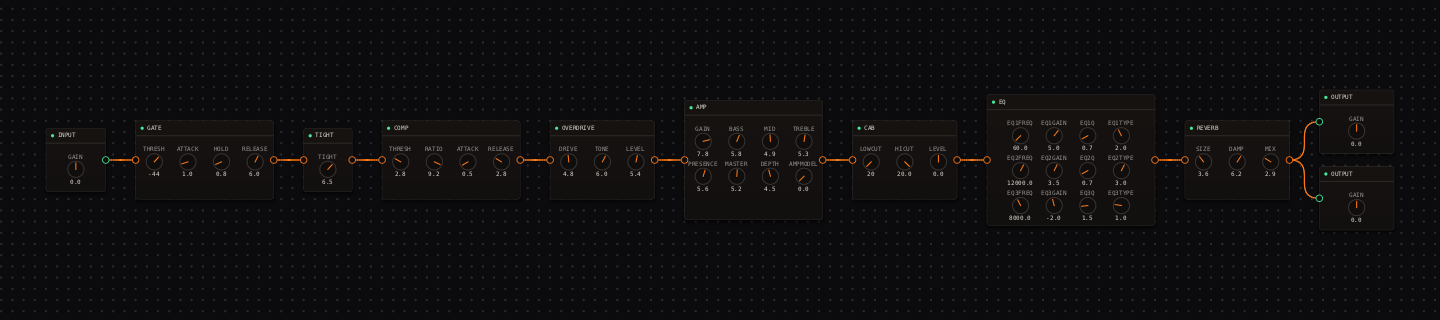
OVERDRIVE 4.8 · 6.0 · 5.4 into the Uberschall model at GAIN 7.8
The classic move: a mid-pushed boost tightening the low end of a high-gain amp so fast riffs stay articulate. The amp is the distortion; the pedal is the focus.
Country-rock: the pedal is the drive
OVERDRIVE 4.7 · 5.3 · 4.9 into a clean Lab Series L5 at GAIN 2.2
The amp stays clean, so here the pedal genuinely is the entire drive character. Same node, opposite role.
Five voicings to start from
The dropdown at the top of the node rewrites all three knobs. Cycle ts808 to klon-centaur to clean-boost against the same riff and the differences teach faster than any description. Values are DRIVE · TONE · LEVEL.
| Voicing | Values | What it is |
|---|---|---|
| ts808 | 5.0 · 6.0 · 5.0 | The mid-hump standard. The blues rig sits a hair off it. |
| clean-boost | 1.0 · 5.0 · 8.0 | Almost no pedal clipping, lots of push. Pure amp aggression. |
| screamer | 8.0 · 7.0 · 5.5 | The hot, bright end of the TS family. |
| klon-centaur | 3.5 · 6.5 · 6.5 | Transparent, treble-forward lift for edge-of-breakup amps. |
| tech21-bass | 5.0 · 5.0 · 6.0 | DI-grind voicing that keeps low-end body. Good on baritone and bass. |
Overdrive on guitar: quick answers
- Should overdrive go before or after the amp?
- Before, always. The whole point of an overdrive pedal is to push the amp harder, so it belongs in front of the AMP node. What varies is what surrounds it: a TIGHT node before it keeps low strings from flubbing into the boost, and a COMP evens out what the amp receives.
- What is the difference between DRIVE and LEVEL on an overdrive?
- DRIVE adds the pedal's own clipping (fizz and fur). LEVEL is how hard the pedal pushes the amp. Into an already-driven amp, more LEVEL adds attack and sustain without the fizz, while more DRIVE piles on pedal grit. When you want "more", reach for LEVEL first.
- How do I get a touch-sensitive overdrive sound?
- Keep DRIVE moderate and let the amp do the clipping, then check the cleanup: roll your guitar volume down to 7. If the rig does not clean up, DRIVE is too high. Touch sensitivity is the feature you buy with moderate settings.
Hear these in a real rig
Open the Randomizer, paste a seed, click Recall.
- Blues tutorial: TS-style push into a fraying JCM800 (the first screenshot).
- Metal tutorial: the tight boost into the Uberschall model (the second screenshot).
- Country-rock tutorial: the pedal as the whole drive over a clean L5.
- Rig Market: community rigs that use OVERDRIVE.
Get the CrossWire demo → Standalone app and CLAP plugin, full fidelity, every seed recalls exactly.