How to use reverb with guitar
The effect every guitarist reaches for first and overuses fastest. Here is what reverb actually does to a guitar, the five kinds worth knowing, and the exact settings we kept landing on while building fourteen real rigs.
CrossWire field notes. Every number below is measured from a rig you can load and hear, not a generic recommendation. Recall the seeds named at the end to put them on your own canvas.
Reverb is the sound of a room. On a guitar its one job is to place the instrument at a believable distance, near and dry or far and washed, without burying the note that started it. Almost everything that goes wrong with guitar reverb is the same mistake in different clothes: the tail ends up louder than the pick, and suddenly the whole part sounds distant, vague and small in a mix.
The cure is an order of operations. There is no magic setting. Shape the space first with the size and damping while the wet level is all the way down, so you are auditioning the character of the room in isolation. Then bring the wet mix up only until you would notice if it disappeared. Stop there. A reverb you can just barely hear on its own is usually exactly right in a band.
The five reverbs, and the room each one is
"Reverb" is really five different spaces, and picking the right one matters more than any knob. Learn them as places and the settings follow.
Room is a small natural space, the everyday default that adds air without announcing itself. Hall is big and bright-tailed, the obvious "cathedral" that suits leads and clean arpeggios. Plate has no room shape at all: a dense, bright studio sheen originally made by vibrating a sheet of metal. Spring is the short, dark, faintly metallic reverb built into vintage amps. Nonlin is the odd one: a short tail chopped off abruptly and mixed loud, the gated-snare sound of eighties records.
In CrossWire these live on the REVERB node’s voicing dropdown. Here are the exact values each recalls, as a starting point rather than a rule:
| Type | Starting point | What it is, and when to reach for it |
|---|---|---|
| Room | SIZE 3.0 · DAMP 6.0 · MIX 3.0 | Small, dark, natural. The everyday default; most rigs live near here. |
| Hall | SIZE 8.5 · DAMP 3.5 · MIX 4.0 | Big and bright-tailed. Leads, cleans, surf. (The surf rig runs a slightly drier 7.4 · 4.7 · 3.0.) |
| Plate | SIZE 6.0 · DAMP 2.0 · MIX 4.0 | Dense and bright; low damping is what reads as "plate". Studio sheen. |
| Spring | SIZE 2.5 · DAMP 7.0 · MIX 3.5 | Short and dark, the vintage amp-pan flavour. |
| Nonlin | SIZE 2.0 · DAMP 8.0 · MIX 4.5 | Short, heavily damped, loud: the gated-80s effect. |
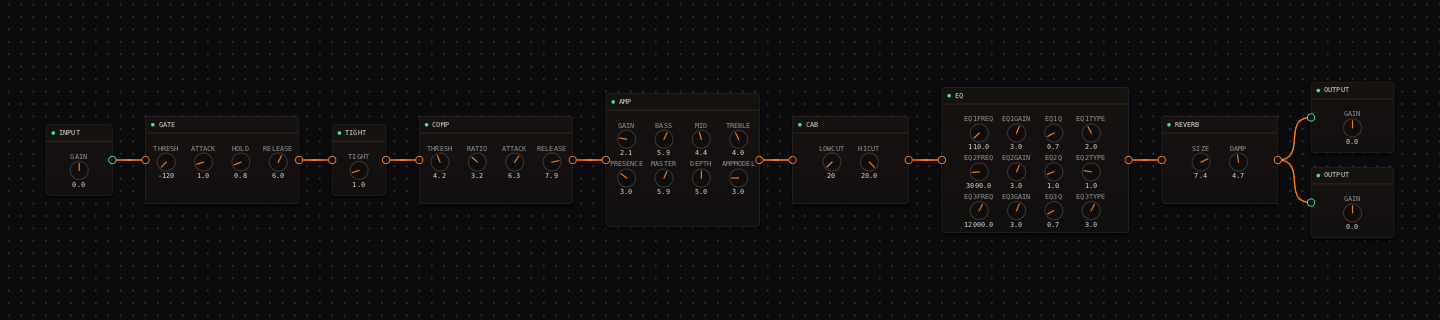
The three knobs that decide everything
The REVERB node keeps it to three controls, all 0–10, defaulting to SIZE 5.0, DAMP 5.0, MIX 3.0. That low default mix is a deliberate nudge toward keeping your dry attack in front.
SIZE: how big the space reads
Small values give a tight, immediate room; large values open a hall. Set this while playing staccato notes, not chords, so you can hear where the reflections start.
DAMP: how fast the top of the tail dies
This is the knob players forget, and it fixes the single most common complaint. When a reverb sounds like "too much," it is usually too bright rather than too loud. Its tail is poking at the same 3–8 kHz region as your pick attack. Drag DAMP up and the tail darkens while its length stays put. Reach for DAMP before you reach for an EQ node or pull the mix down.
MIX: wet against dry
The last knob you touch, not the first. Set size and damp with mix at zero, then raise mix until the tail sits behind the note. If you find yourself wanting less reverb, try darkening DAMP before lowering MIX. Dark tails sit surprisingly loud without masking anything.
Where reverb belongs in the chain
Last, after the cab and any EQ, so the space hears the finished tone rather than re-processing a half-built one. That is why the screenshot above has REVERB at the end. The one move worth learning beyond "put it last" is the parallel lane: instead of running your signal through the reverb, split it so a dry copy runs straight to the output while a second copy feeds the reverb, and let the two rejoin. Now the dry attack is completely untouched no matter how wet the tail gets, which is how the shoegaze and indie rigs keep a giant wash without losing the riff. In CrossWire you build it by wiring the cab into both the reverb and the next stage; the engine drops in a MIX node automatically when two wires land on one input.
When a natural room isn’t the point: SPACE
CrossWire ships a second, stranger reverb, the SPACE node, for when the REVERB node’s tails feel too familiar. Instead of modelling a real room it generates one from a SEED knob (0–99), each value a genuinely different synthetic space: some metallic, some soft, none of them any real place. The ambient tutorial ends in one at SEED 88 with the damping wide open. It is the door out of "guitar in a room" and into "guitar somewhere that doesn’t exist." If you write ambient or post-rock, start there rather than with a bigger hall.
Three mistakes we hear most
- Mixing reverb by loudness instead of by darkness. Turning the wet level down thins the whole effect to a whisper. Darken DAMP instead and the space stays full while it stops fighting the note.
- Reverb before the drive. A tail that gets re-distorted turns to porridge. Keep reverb after the amp and cab; only break that rule on purpose, for a specific lo-fi splash.
- One giant hall on everything. Rhythm parts want a small darker room so they stay articulate; save the big bright tails for sparse leads and ambient work. Matching the space to the part beats any single "best" setting.
Reverb on guitar: quick answers
- How much reverb is too much on guitar?
- If the reverb is louder than your pick attack, it is too much. Set the space with the size and damping first, then raise the wet mix only until you would miss the tail if it vanished. In a band that is almost always less than it sounds like alone. Most "too much reverb" is really too much wet level drowning the note’s front.
- Should reverb go before or after distortion?
- After. Reverb hears the finished tone last in the chain, so its tail carries a clean copy of your sound. Put it before the drive and the amp re-distorts the tail into mush. The one deliberate exception is a spring reverb slammed into the front of a vintage amp for a lo-fi splash, worth trying but rarely the default.
- What reverb is best for clean guitar versus lead?
- Clean rhythm wants a small, darker room so it stays articulate. Leads can take a bigger, brighter hall or plate because there are fewer notes to smear. Ambient and post-rock parts go further still, into a long generated space rather than a natural room.
- What is the difference between spring, plate and hall reverb?
- Spring is short, dark and metallic, the sound built into vintage amps. Plate is dense and bright with no obvious room shape, the classic studio vocal-and-guitar reverb. Hall is the biggest and most obviously "a space," with a long bright tail. Room sits under all of them: small, natural, everyday.
Hear these settings in a real rig
Every value above comes from a rig you can load in seconds. Open the Randomizer, paste a seed, click Recall, and the canvas rebuilds itself.
- Surf tutorial: the hall in the screenshot (SIZE 7.4), reverb as the identity of the tone.
- Classical tutorial: a small damped room sitting behind fingerstyle.
- Ambient tutorial: the generated SPACE room, SEED 88.
- Rig Market: community rigs that use REVERB, browsable by node.
Get the CrossWire demo → Full audio fidelity, standalone app plus the CLAP plugin, and every seed above recalls exactly.